IRS Eliminates Paper Tax Refund Checks: What SDG Accountant Clients Need to Know for 2026

IRS Eliminates Paper Tax Refund Checks

Starting October 1, 2025, the Internal Revenue Service stopped both accepting paper checks for tax payments and issuing paper refund checks. This change, prompted by a federal executive order with a September 30, 2025, cutoff, is part of a broader federal initiative to move entirely to electronic transactions to improve efficiency, lower costs, and reduce fraud and theft risks linked to paper checks.

This initiative is part of a broader modernization effort required under Executive Order 14247, aimed at improving efficiency, security, and overall taxpayer experience.

At SDG Accountant, we want to ensure you are prepared for this digital shift so your refund—money you’ve worked hard for—arrives safely and without unnecessary delays.

Why the Change?

The move away from paper is part of a broader federal initiative to modernize government payments. According to the IRS and the Department of the Treasury, the benefits are clear:

  • Security: Paper checks are 16 times more likely to be lost, stolen, or fraudulently altered compared to electronic payments.
  • Speed: Electronic refunds are typically issued within 21 days. In contrast, paper checks can take six weeks or longer to arrive by mail.
  • Cost Efficiency: Phasing out paper is estimated to save the federal government over $600 million annually in printing and postage costs.

What does this mean for you?

If you are among the 93% of taxpayers who already use direct deposit, your experience won’t change. However, if you are part of the 7% who still rely on paper checks, you must take action before you file your 2025 return.

Starting with the 2026 filing season, the IRS will no longer offer a “paper check” checkbox as a standard refund option on tax software. Taxpayers will be prompted to provide banking information or select an alternative electronic method.

  • 👉 Prepaid Debit Cards: Many reloadable cards have account and routing numbers that can be used for direct deposit.
  • 👉 Digital Wallets: Certain mobile payment apps now provide routing numbers specifically for federal deposits.
  • 👉 Low-Cost Accounts: The IRS encourages using resources like FDIC GetBanked to find no-fee or low-cost banking options.

While limited exceptions will exist for those with religious objections, disabilities, or extreme hardships, they are not automatic. Taxpayers who fail to provide banking information and do not have an approved exception may have their refunds held for at least six weeks while the IRS verifies their status, eventually resorting to a manual check.

How to Prepare Now?

To avoid any disruption when you file this January, we recommend taking these steps:

  • Verify Your Info: Double-check your bank account and routing numbers. Even a single-digit error can cause your refund to be bounced back to the Internal Revenue Service.
  • Open an Account: If you don’t have one, now is the time to set up a basic savings or checking account. Confirm accurate bank details before filing your return. Then choose direct deposit when filing taxes.
  • Consult Your Tax Professional↗: If you have concerns about how this transition affects your specific situation—especially for international taxpayers or those with complex filings—reach out to us↗.

How SDG Accountants Can Help?

At SDG Accountants & Enrolled Agents, we stay ahead of IRS changes so our clients don’t have to worry. Our tax professionals help individuals and businesses:

  • File accurate tax returns
  • Set up direct deposit correctly
  • Avoid refund delays and errors
  • Stay compliant with IRS updates
  • Maximize refunds while minimizing risk

Final Thought

The IRS’s phasing out of paper tax refund checks marks a significant shift toward a faster, more secure tax system. While change can feel inconvenient, electronic refunds ultimately benefit taxpayers through speed, safety, and reliability.

As we head into the 2026 filing season, electronic payments aren’t optional anymore—they’re becoming the federal standard. At SDG Accountant, we’ll make sure your estimated tax payments, balance-due payments, and any IRS remittances are set up correctly and credited to the correct account, so nothing gets delayed, misapplied, or lost.

If you’re unsure how this change affects you or want expert guidance, Miami Accountant is here to help. 👉 Contact SDG Accountant & Enrolled Agent today to prepare for the future of digital tax refunds.
IRS Form 8854 and U.S. Expatriation Tax: A Guide for Expats

IRS Form 8854

In order to renounce your US citizenship, you are required to submit several forms. One of the vital forms that needs to be submitted is IRS Form 8854. Until you have submitted this form, the Internal Revenue Service will still regard you as a citizen of the United States.

In this article, we will explore in detail the particulars of Form 8854, who qualifies to submit it, and who stands to gain the most from it.

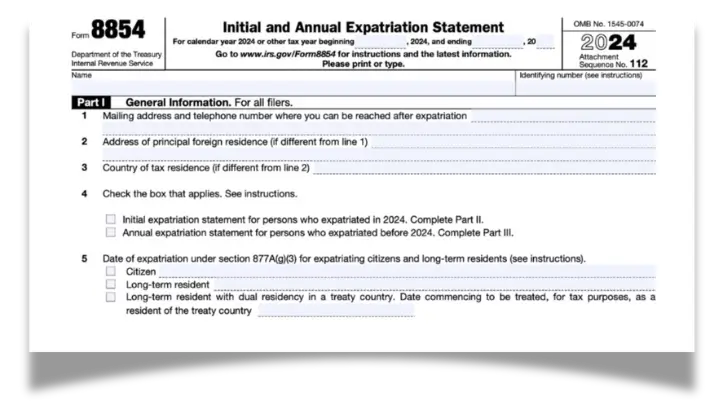
What Exactly Is Form 8854?

Form 8854 is an IRS tax document that is meant to declare one’s U.S. taxes settled once and for all. Until you provide proof that you’ve settled all your dues, the government will continue to regard you as a citizen for tax remittance purposes and expect you to submit taxes regularly.

In the same way, Form 8854 also decides whether you fall within the category of a covered or non-covered expat. If you fall under the covered expat category, you will also need to pay an exit tax as part of your declaratory renunciation.

Who Needs to Submit IRS Form 8854?

Filing IRS Form 8854

Form 8854 must be filled out by U.S. citizens planning to renounce their citizenship. Some long-term residents also need to submit this form when they stop being residents of the United States. More specifically, U.S. residents who have maintained a Green Card for at least eight years out of the last fifteen must complete Form 8854 if they wish to be classified as non-residents.

✅ Form 8854 IS Required If…

A resident alien (typically a green card holder) must file Form 8854 if:

  • Gave up their green card, or had it administratively or judicially revoked or abandoned (e.g., filed Form I-407 with USCIS).
  • They are a “long-term resident” (i.e., held a green card in at least 8 of the last 15 tax years), and they have officially expatriated — meaning they either:
  • This falls under the expatriation tax rules (IRC §877A) and triggers a requirement to file Form 8854, which is a statement of expatriation and a net worth/income/assets disclosure.

❌ Form 8854 Is NOT Required If…

A resident alien leaves the U.S. temporarily or gives up their U.S. residency without meeting the “long-term resident” definition. Specifically:

  • You are not a green card holder (e.g., on a work visa like H1B), or
  • You’ve had a green card for less than 8 out of the last 15 years, or
  • You just leave the U.S. and don’t officially abandon your green card.
  • In these cases, Form 8854 is not required.

What Is a Covered Expatriate?

Deciding whether you are a covered or non-covered expat will significantly affect the costs you incur in renouncing your citizenship. In reality, this single determination may drive your finances, determining if renouncing your citizenship is worthwhile at all.

What, then, is the distinction between a covered and non-covered expat? Simply put, covered expats must pay an exit tax when they renounce or terminate their citizenship, while non-covered expats do not.

Who Is Considered a Covered Expatriate?

A covered expatriate is someone who the IRS considers as any of the following standards:

  • Net Worth Test: Your net worth is more than $2 million during expatriation.
  • Tax Liability Test: Your yearly average income tax liability for the last five years crosses a particular figure.
  • The figure is set at $190,000 (adjusted for inflation every year) for the 2024 filing date.
  • If you can prove the above conditions, you will be compelled to pay the exit tax, which affects covered expatriates who give up citizenship or conditional expatriate residency.
  • You haven’t filed or paid your taxes in any of the last five years.

In any of the above circumstances, you are a covered expat and will incur an exit tax. If not, you are a non-covered expat, and the exit tax does not apply to you. In both situations, you must file Form 8854 to determine whether you are covered or noncovered.

Miami Accountant

Never had a pro tax help before?

Get the best advice from our experts

What is the Method for Avoiding the Exit Tax?

Suppose you expatriate as a covered expatriate in the same year you expatriated. In that case, you will incur an income tax liability on the net unrealized asset value (NUA) of your property at the applicable income tax rate on unrealized gains. This assumes the property was disposed of at FMV on the day before the expatriation. As a fundamental taxation principle for non-citizens (expatriates), it is presumed to occur on the day before the date of expatriation.

In other countries, this is commonly known as the “exit tax.”

But there are exceptions for dual citizens and certain minors:

  • One of the prerequisites for dual citizens is that they must have become US citizens and citizens of another country at birth. Upon expatriation, they must continue to be a citizen and tax resident of this other country.
  • Certain minors will qualify for the exception if they expatriated before the age of 18 ½ and were not residents of the U.S. for 10 years before expatriating.

Penalties for Failing to File IRS Form 8854

Failing to file Form 8854 when required can result in a $10,000 penalty and potential ongoing tax consequences under the expatriation rules.

Penalty for Form 8854

The total cost for failing to submit a Form 8854 can be extreme. The first penalty is the noncompliance penalty, which is set at $10,000. (This only applies to covered expats.)

On top of this, assuming you do not submit Form 8854, you will be regarded as an American citizen and, as such, will remain bound to US citizenship-based taxation. This entails being liable for taxes incurred before filing, along with interest and fines attached for the delay.

It does not matter if you are labeled as a covered or non-covered expat; the ideal approach is always to submit this form as required.

Instructions to Complete and Submit Form 8854

Completing Form 8854 comes with unique challenges. For such reason, we do not recommend attempting to fill out this specific form yourself due to potential consequences such as penalties for making even the slightest of errors and miscalculations.

Consider the Case: if you wish not to be deemed a covered expat, you need to attest on Form 8854 that you have been fully compliant with the tax obligations for the last five years – this is something that poses a risk of contention and comes with substantial penalties if the taxpayer is erroneous.

Our best advice for safeguarding your interests is to seek a U.S. Expat Tax advisor like the SDG Accountants and file IRS Form 8854 with precision for security and peace of mind.

🔁 What to File Instead (if applicable):

If the individual is not filing 8854 but is ending U.S. tax residency, they may need to:

  • File a dual-status return for the year of departure (Form 1040 + 1040-NR),
  • Attach a residency termination statement,
  • Possibly file Form 8840 (closer connection), or
  • Maintain records for Form 8833 if taking a treaty position.

Still Have Questions about IRS Form 8854 and Your Expat Taxes?

We hope this post has helped you understand what Form 8854 means to you as a U.S. expat.

Contact us, and one of our Miami Tax Accountant will gladly help. If you need very specific advice on your specific tax situation, you can also click below to get a consultation with one of our expat tax experts.

Filing Taxes as a US Expat

US Expat

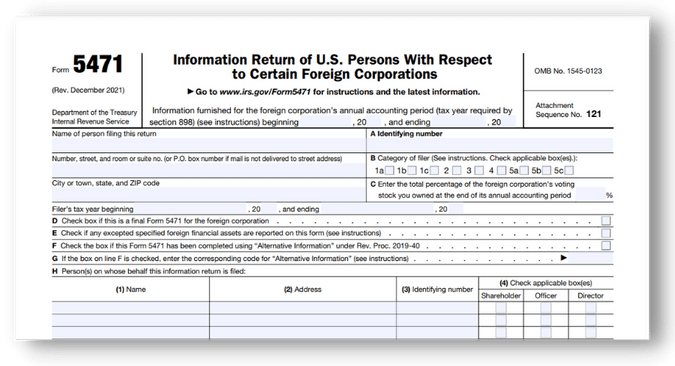
Have you lately migrated to another country for business? If you answered yes, you are now officially a US expat. Living overseas for professional reasons can be a significant shift in terms of both physical and mental health, but it also has tax implications. Many expat business owners are unsure how to handle their taxes after relocating. This article will discuss the tax obligations of an expat business owner, with a particular emphasis on Form 5471 and its requirements.

IRS Form 5471: What is it and who must file it?

If you are a US citizen or resident alien and are an officer, director, or shareholder in certain foreign corporations, you must file IRS Form 5471, Information Return of US Persons with Respect to Certain Foreign Corporations, along with your expat taxes.

When filing your expat taxes, it is critical to consult with your Tampa tax accountant to ensure that you file correctly and on time.

Many US expats misread the regulations about who must file Form 5471. To put it simply, the filing requirement applies to every US person (including US residents, partnerships, companies, trusts, and estates) who owns at least 10% of a foreign corporation.

To be more specific, the IRS has identified four main categories of US persons who must file Form 5471 along with their yearly US expat taxes:

shareholder

Category 1 Filer:

A Category 1 filer is a U.S. shareholder of an SFC who owned that stock on the last day of the SFC’s taxable year at any time through the SFC’s taxable year. An SFC is any foreign corporation in which one or more domestic corporations are shareholders in the United States.

Category 2 Filer:

A Category 2 Filer is a US citizen who is an officer or director of a foreign corporation and holds 10% or more of the foreign corporation’s stock.

Category 3 Filer:

foreign corporation

If a US person does any of the following during the year, they meet the qualifications of a Category 3 Filer with respect to a foreign corporation:

  1. Acquires shares in a foreign corporation, which, when added to any stock acquired on the date of acquisition, fulfills the 10% stock ownership criterion.
  2. Acquires more stock that meets the 10% stock ownership requirement.
  3. Becomes a U.S. person while meeting the 10% stock ownership requirement.
  4. Sells enough shares in the foreign corporation to reduce his or her ownership position to less than 10%.
  5. Satisfies the requirements for 10% stock ownership in the corporation at the time the corporation is reorganized.

Category 4 Filer:

A US person is a category 4 filer if he possessed control of a foreign corporation during the foreign corporation’s fiscal year. Persons with control are defined by the IRS as anyone who holds more than 50% of the entire combined voting power of all classes of stock entitled to vote, or more than 50% of the total value of shares of all stock of the foreign corporation.

Category 5 Filer:

US shareholder

A category 5 filer is either a US shareholder of a CFC at any point throughout the CFC’s taxable year or owns stock in the foreign corporation on the last day of the fiscal year in which the corporation is a CFC. A CFC is a foreign corporation with U.S. shareholders who own more than 50% of the total combined voting power of all classes of voting stock or the entire value of the corporation’s stock on any day during the tax year of the foreign corporation.

Contact your Tampa Tax Accountant, SDG Accountants Ltd., now for more information on who needs to file Form 5471 and if you fulfill the requirements. We can answer any queries you have concerning US Expat Taxes in Tampa.

US Expat Tax Filing Deadline:

Tax Filing Deadline

If you fall into one of the five categories listed above, you must file Form 5471 together with your US expat taxes. Due to a two-month delay granted to residents living abroad, the deadline for the US Expatriate tax is June 15th, rather than Tax Day (April 18th). If you are unable to fulfill the above deadline, the IRS will grant you an extension until October 16th. Those who fail to fulfill the deadlines face penalties and interest from the IRS.

Expat business owners may find expat tax filing and the obligations associated with it challenging to understand and comply with. It is critical to speak with an experienced US expat tax accountant to ensure that no mistakes are made during your filing. To get started, call SDG Accountants now or schedule a free introductory consultation. We are delighted to serve as your new Tampa tax accountants.